That grinding noise is your brakes talking
Squeal, grind, pulsation and a soft pedal all mean different things. What each brake noise actually is, how long you've got, and which one means stop driving.
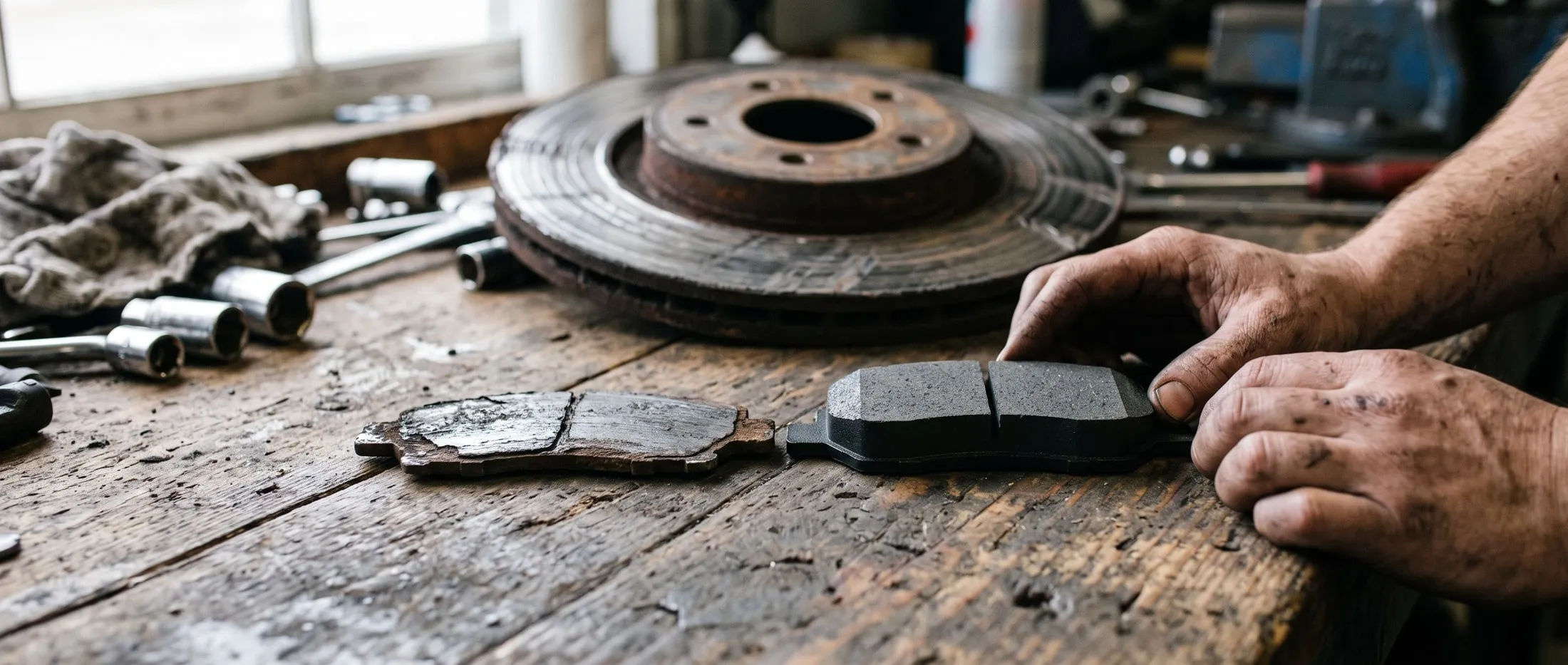
Brakes are unusually good at telling you what’s wrong, if you know what the sounds mean. Here’s the translation, roughly in order of how worried to be.
Light squeal on the first stop of a damp morning
Surface rust burning off the rotor face overnight. It goes away after a stop or two and it means nothing at all. Cars that sit outside in Virginia humidity do this constantly.
How worried: not at all.
A steady high-pitched squeal that follows you all day
That’s the wear indicator — a small spring-steel tab riveted to the pad, positioned to start scraping the rotor when the friction material gets down to about 3mm. It exists to make an annoying noise while there is still pad left.
It is doing exactly what it was designed to do. You have some time. You do not have a lot of it.
How worried: get it looked at in the next couple of weeks.
Grinding, growling, a sound like gravel
The friction material is gone. That is the steel backing plate of the pad against the face of the rotor, and every stop you make is cutting a groove into a part that costs several times what the pads did.
Two things are happening at once. Your stopping distance is longer than it should be, and the repair bill is climbing while you drive. A pad-and-resurface job just turned into pads and rotors, and if it goes on long enough, a seized caliper too.
How worried: call us. Don’t put it off for a week to see if it goes away.
A pulsation through the pedal
You press the brake and feel a rhythmic push back, usually worse from higher speed. People call this “warped rotors” and that’s not quite right — it’s almost always thickness variation, where parts of the rotor face have worn down more than others, so the pads squeeze a surface that isn’t the same thickness all the way round.
Sometimes it’s pad material transferred unevenly onto the rotor, which can occasionally be cleaned up. Usually the rotor needs resurfacing or replacing.
If you feel the shimmy through the steering wheel instead of the pedal, and only under braking, that’s typically the front rotors. If you feel it at speed without braking, that’s a tire or balance issue rather than brakes.
How worried: it’s a comfort and control problem now and a bigger bill later. Get it looked at.
A soft, spongy, or sinking pedal
This one is different from all the others because it’s hydraulic rather than friction. A pedal that goes further than it used to, or slowly sinks toward the floor while you hold it at a light, means one of: air in the lines, a fluid leak, a failing master cylinder, or brake fluid that has absorbed enough moisture to boil under heat.
That last one deserves a moment. Brake fluid is hygroscopic — it pulls water out of the air over the years. Water boils at a much lower temperature than brake fluid, and boiling produces gas, and gas compresses. That’s how you get a pedal that works fine around town and then goes to the floor coming down a long grade with a loaded car.
How worried: this is the one on this page that means “do not drive it, call us.”
What we do about it
We measure. Every pad on all four corners in millimetres, every rotor against the minimum thickness cast into the part itself. Then we photograph the measurement and send it to you before anybody quotes a number.
That last bit matters more than it sounds. Every rotor has a minimum thickness stamped on it. If cutting it would take it below that number, it cannot be resurfaced safely — and that is arithmetic, not opinion, which is why we’d rather show you the two numbers than argue about it.
Worn brakes are also one of the more common reasons a car fails its Virginia state inspection, which is a much better way to find out than the alternative.
If something on this page describes your car, call (804) 737-2828 or plan a drop-off. We measure the pads and rotors, show you what we found, and quote the work before you decide anything.