What a check engine light actually costs to figure out
A free code read gives you a number, not an answer. What real diagnosis involves, why the fee gets credited to the repair, and when the light means pull over now.
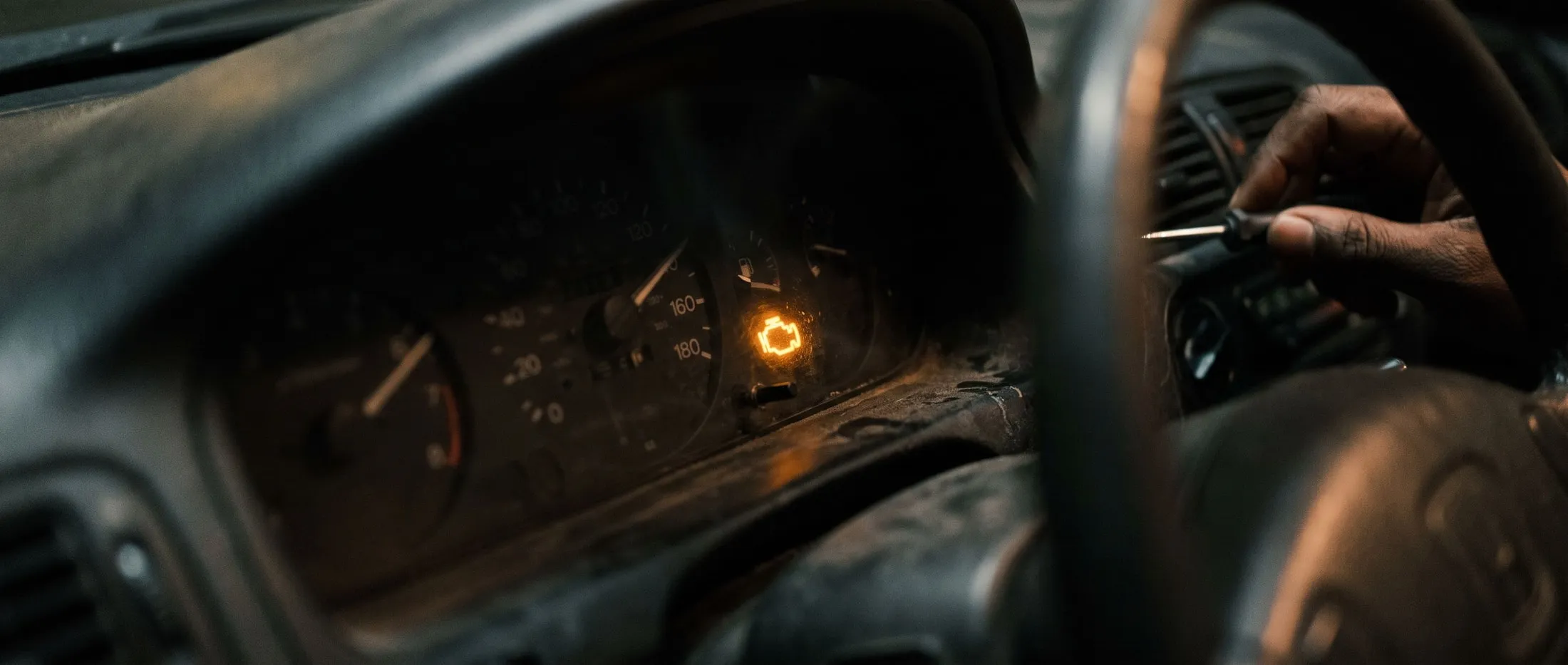
The parts store will read your codes for free. That’s a real service and it’s worth using — it tells you whether you’re dealing with something trivial or something that needs attention.
What it does not give you is a diagnosis, and the gap between those two things is where a lot of money gets wasted.
A code is a symptom
Take P0171 — “System Too Lean, Bank 1.” It’s one of the most common codes there is. What it means is that the engine computer has been adding fuel to compensate for something, and it has run out of room to compensate.
What it does not tell you is why. The list of things that produce a lean condition includes a vacuum leak, a cracked intake boot, a failing mass airflow sensor, a weak fuel pump, a clogged filter, dirty injectors, an exhaust leak ahead of the oxygen sensor, or — sometimes — a genuinely bad oxygen sensor.
Every one of those sets the same code. Only one of them is your problem.
The number of perfectly good oxygen sensors sold on the strength of P0171 every year would fill this building.
What real diagnosis involves
- A full scan of every module, not just the engine. Faults in one system routinely produce symptoms in another.
- Freeze frame data — the snapshot of conditions the computer captured at the moment the fault set. Engine temperature, load, speed, fuel trims. That tells you whether it happens cold, hot, at idle or under load, which narrows things enormously.
- Live data under real conditions. Fuel trim numbers at idle versus at 2,500 rpm answer questions a static scan can’t. A vacuum leak behaves very differently at idle than at speed.
- A smoke test if a vacuum or EVAP leak is suspected. Machine-generated smoke pushed into the system, then you look for where it comes out. This is how you find a cracked hose behind an intake manifold in ten minutes instead of two hours.
- Testing the component before condemning it. Back-probe the connector, check the signal, check the ground, check the power feed. A sensor with a corroded ground reports exactly like a failed sensor and costs nothing to fix.
That’s typically an hour or two of a technician’s time and specialized test equipment. The shop confirms the diagnostic charge before testing begins, then explains what the results mean before any repair is approved.
Steady light or flashing light
This distinction is worth memorising.
Steady — the computer has logged a fault and wants it looked at. This week is fine. This month is pushing it. The car is not in danger this afternoon.
Flashing — an active misfire severe enough to dump unburned fuel into the exhaust. Raw fuel in a catalytic converter burns, and a converter that overheats badly enough is destroyed, and a converter is one of the most expensive parts on a modern car.
A flashing light means reduce load, get off the road, and call. Every mile matters on that one.
Try the free thing first
If your light came on shortly after a fuel stop, check the gas cap. A loose or cracked cap genuinely does set an EVAP code. Tighten it until it clicks, then drive normally for a few days — the computer needs several complete drive cycles to re-run the test and turn the lamp off by itself.
If it comes back, the leak is somewhere else, and finding it takes a smoke machine rather than a guess.
“It went off by itself. Am I fine?”
The lamp went out because the condition passed its self-test for enough consecutive drive cycles. The stored code is still in there, along with the history of how many times it’s happened.
That history is useful, which is why we still recommend a scan. And the fault will very likely come back — intermittent faults are intermittent, not cured.
Does it fail a Virginia inspection?
Not on its own. Virginia’s statewide annual inspection is a safety inspection — brakes, tires, steering, lights, glass, exhaust. A check engine light is not a listed safety item, so it does not by itself fail the state inspection.
Emissions testing is a separate program that applies in certain Northern Virginia localities, not here. In that program a lit check engine light is an automatic failure.
Around Sandston the practical answer is simpler than either rule: the light is on because something is broken, and it will not get cheaper.
What you should get at the end
A written explanation of what is actually wrong, in words that make sense, with the evidence attached. Not a code number and a parts list.
That’s what the fee buys, and it’s why we credit it against the repair — we’d rather be paid for finding the problem than for replacing parts until the light goes out.
Need a real answer rather than another code read? Call (804) 737-2828 or plan a drop-off for diagnostics.