Alignment, balancing, rotation: which one do you actually need?
Three different services that get confused constantly. What each one fixes, what symptom points to which, and what happens when you buy the wrong one.
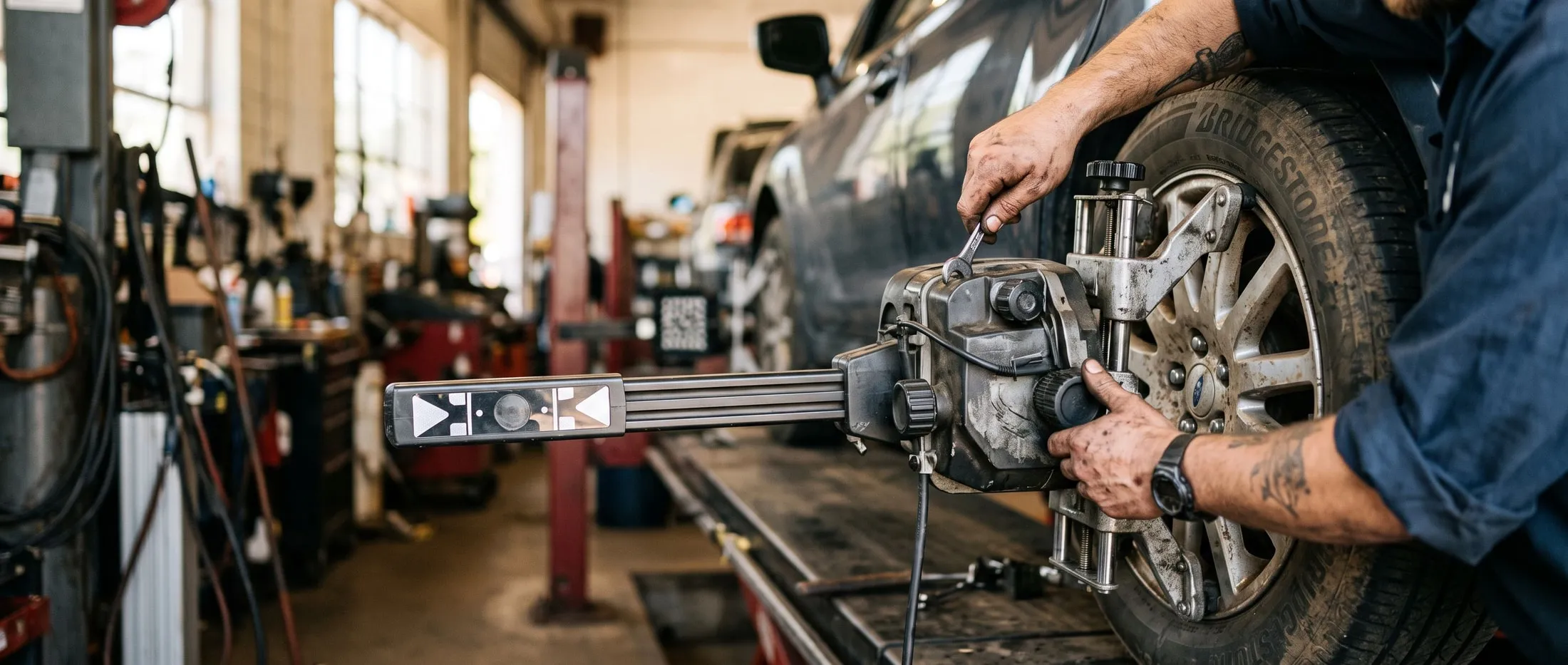
These three get used interchangeably at counters all over the country, and they are three completely different jobs fixing three completely different problems. Buying the wrong one is common and it doesn’t fix anything.
Rotation — moving the tires around
What it is: taking the tires off and putting them back on in different positions, usually front to back.
Why it exists: the front and rear of a car wear tires at different rates. On a front-wheel-drive car the fronts do the steering, most of the braking and all of the driving, so they wear roughly twice as fast. Moving them around evens that out and gets you the full life from the set.
What it fixes: nothing acute. It’s preventive. It’s the cheapest way to not buy tires early.
When: every oil change is the right rhythm — roughly every 5,000 to 7,500 miles. It’s free with most services here.
Balancing — making the wheel spin true
What it is: spinning each wheel-and-tire assembly on a machine that detects where it’s heavy, then clamping small weights to the rim to counteract it.
Why it exists: no tire is perfectly uniform. A few grams out at 70 mph becomes a real force, several times a second.
What it fixes: vibration at speed. Classically it comes in around 55–70 mph, gets worse as you speed up, and eases off when you slow down. Front wheels usually shake the steering wheel; rear wheels usually shake the seat and floor.
When: any time a tire is mounted, and any time you develop a speed-related vibration. Weights fall off — hitting a curb will do it.
Alignment — pointing the wheels correctly
What it is: measuring and adjusting the angles at which the wheels meet the road. Three matter:
- Toe — whether the wheels point inward or outward relative to each other, looking down from above. This is the one that destroys tires fastest.
- Camber — whether the top of the wheel leans in or out, looking from the front.
- Caster — the fore/aft tilt of the steering axis. It’s mostly about steering feel and self-centring.
Why it exists: those angles get knocked out by potholes, curbs, and by the gradual wear of suspension bushings and joints. Williamsburg Road, the airport approaches and the I-64 ramps are not gentle.
What it fixes: a car that pulls to one side on a flat road. A steering wheel that sits crooked while you’re going straight. And, most expensively, one edge of a tire wearing far faster than the rest.
When: once a year is sensible around here. Always with new tires. Always after suspension or steering work. And any time you hit something hard enough to make you wince.
The quick diagnosis
| What you feel | Which one |
|---|---|
| Shaking at 60 mph, smooth at 40 | Balancing |
| Car pulls left or right on a flat road | Alignment |
| Steering wheel crooked when going straight | Alignment |
| Inside or outside tire edge worn away | Alignment |
| Fronts worn out, rears look new | Rotation (or lack of it) |
| Shudder only when braking | Neither — that’s brakes |
| Hum or growl that changes when you turn | Neither — that’s a wheel bearing |
Those last two are on the table because they get misdiagnosed as tire problems constantly. A vibration under braking is rotors. A speed-related hum that changes pitch as you turn is a wheel bearing, and it will get louder until it stops being a noise.
The expensive mistake
Buying four tires without an alignment when the old ones were wearing unevenly.
The uneven wear was the symptom. The alignment was the cause. New tires on an out-of-spec car will wear exactly the same way, and the second set will be ruined in a third of the mileage. It’s the single most common way people spend money twice in this category.
We read tire wear patterns on every vehicle that comes through here — including cars in for nothing but an oil change — precisely because the tread tells us what the suspension has been doing long before the driver notices anything.
What you should get on paper
For an alignment, a before-and-after printout showing each angle against the manufacturer’s spec. It’s one of the few repairs where you can see the proof, and you should keep it.
If somebody aligns your car and hands you nothing, ask why.
Call (804) 737-2828 or tell us you’re coming.