Your battery doesn't die in winter. It dies from last summer.
Heat kills car batteries; cold just exposes the damage. Why the January no-start began in July, and the two-minute test in the fall that prevents it.
Every January a lot of people in Henrico County discover their car won’t start on the first genuinely cold morning of the year, and every January a lot of people conclude that the cold killed the battery.
The cold didn’t kill it. The cold just asked it a question it could no longer answer. The killing happened in July.
What heat actually does
A lead-acid battery is plates in acid, and heat accelerates every chemical process in there — including the ones that destroy it. Sustained high temperatures cook off electrolyte, accelerate grid corrosion inside the plates, and permanently reduce the battery’s capacity. That damage does not reverse when the weather cools.
Under-hood temperatures in a Virginia August are brutal — well above the outside air. A battery that spends three summers there has been through the worst thing that can happen to it.
What cold does
Cold does two things at once, and they work against each other.
It slows the chemistry inside the battery, so it can deliver less current. And it thickens the engine oil, so the starter needs more current to turn the engine over.
So on a 20-degree morning your battery has maybe half the cranking power it had in the summer, and the engine needs considerably more. A healthy battery has enough margin to absorb that. A battery that lost 40% of its capacity to three summers of heat does not.
That’s the whole mechanism. The cold morning is the test, not the cause.
The signs you get first
You almost always get warning. It’s just quiet.
- The engine cranks a little slower than it used to, especially first thing
- Headlights noticeably dim at idle and brighten when you rev
- The car needs a jump once, and then seems fine for weeks
- Dash lights flicker when the starter engages
- The battery is more than three years old (in this climate, that’s the number)
That “jumped it once and it’s been fine” pattern is the most misleading one on the list. A battery that has failed once has failed. It didn’t heal.
Battery, alternator, or starter
These get confused constantly, and buying the wrong one is a common way to spend money twice.
Rapid clicking, lights dim → battery too weak to turn the engine.
One loud clunk, lights stay bright → more often the starter.
Jump-starts fine, runs twenty minutes, dies again → alternator. The car was running off the battery because nothing was recharging it. A new battery on an alternator fault buys you a few days and the same tow.
Brand new battery, flat within a week, no obvious cause → parasitic draw. Something is still drinking current after the car goes to sleep — a glovebox light, an aftermarket accessory, a module that never powers down. It’s a patient test rather than a hard one, and it beats buying batteries forever.
The two-minute test
A load test is not a voltage reading. Any battery can show 12.4 volts sitting still and still fail the moment it’s asked for 500 amps. A load test applies a real draw and watches what the voltage does under it.
We do it free with any service, and it takes about two minutes. October is the right month — before the cold arrives, after the summer has done its damage.
Two minutes in the fall is a better deal than a jump start in a Food Lion parking lot in January.
While we’re in there
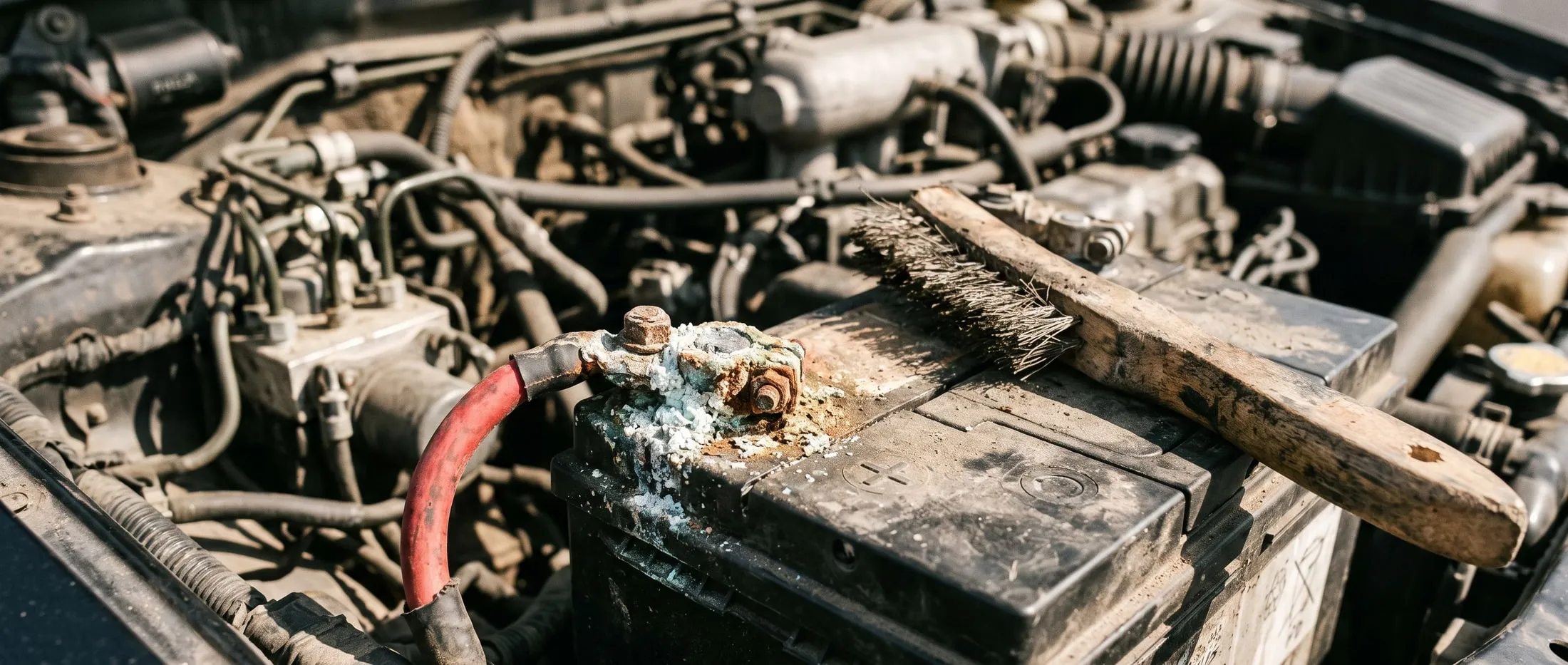
Terminals and grounds matter more than most people expect. Green or white crust on a terminal is resistance, and resistance at the battery post looks exactly like a dead battery from the driver’s seat. It cleans up in a few minutes.
Same for the ground strap from the engine to the body. A corroded ground causes an impressive variety of strange electrical symptoms that get blamed on much more expensive things.
How long should a battery last here?
Three to five years in central Virginia. Northern climates get more; hotter climates get less. Once you’re past three, get it load-tested at every oil change, and don’t be surprised when it’s the heat that got it.
Free testing with any service — call (804) 737-2828 or read more about batteries, starters and alternators.