Broke down on I-64? Do these four things first.
What to do in the first two minutes after your car quits on I-64 near Richmond — in the order that actually keeps you safe, from a shop a mile off Exit 197.
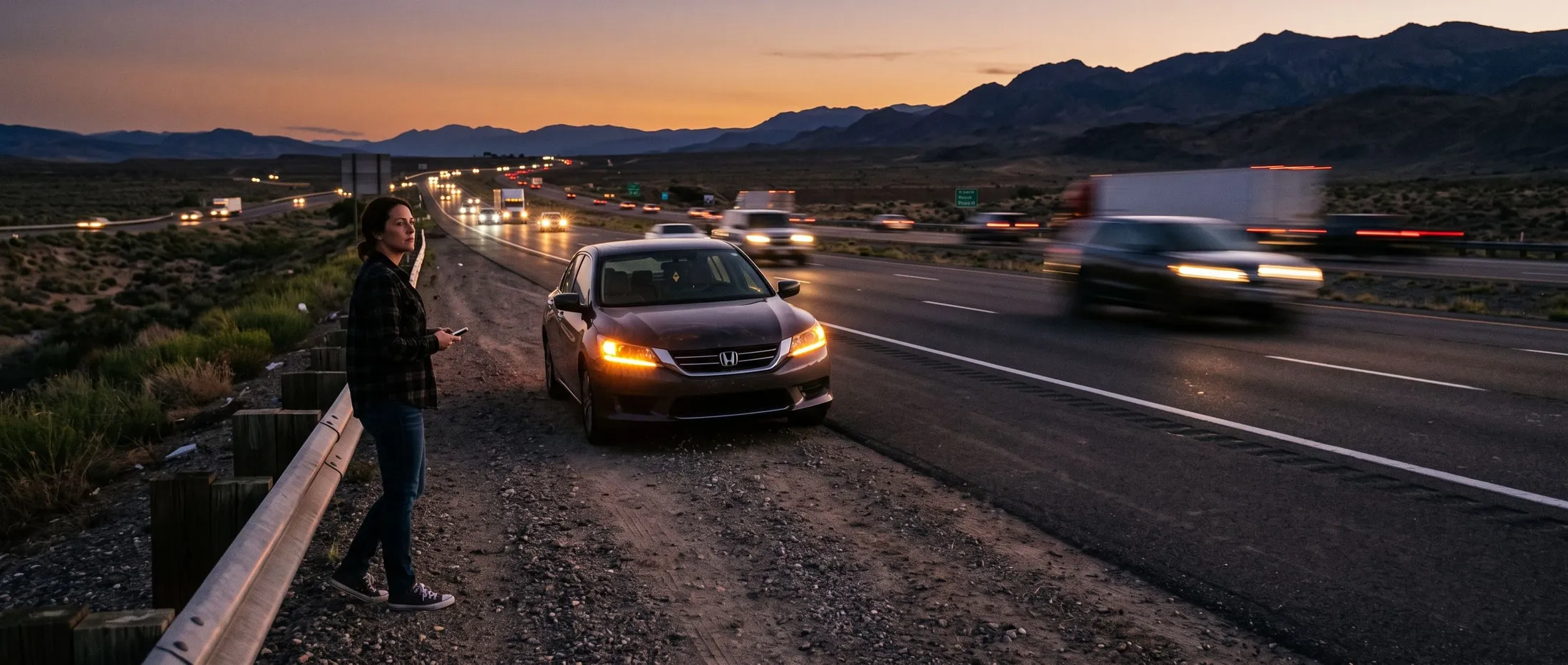
We’re a mile from Exit 197, which means a large share of what we tow comes off this stretch of interstate. Here is what to do, in order, in the first two minutes. The order matters more than any single item on the list.
1. Get out of the travel lane
If the car will still move at all — even barely, even on a flat tire, even with the engine screaming — get it onto the right shoulder. A flat tire driven a quarter mile at 15 mph is a destroyed tire. It is also a tire, and tires are cheap compared with being stopped in a live lane on I-64.
If it will not move, do not get out into traffic to push it. That trade is not worth making.
2. Get visible
Hazard lights on immediately. If it’s dark, leave the parking lights on too. If you carry triangles or flares, set them out well back up the road — further than feels necessary. On a 70 mph road, “well back” means a couple of hundred feet, not twenty.
Traffic approaching at highway speed needs distance to react. Everything you do in this step is about buying that distance.
3. Find your mile marker
This is the step most people skip and the one that costs the most time.
“Near the airport” covers several miles of interstate in both directions. The small green mile markers on the shoulder are the single fastest way for a tow truck, a state trooper, or a Safety Service Patrol driver to find you. Look for the nearest one and note the number, and note which direction you were heading — east or west.
If you can’t see a marker, the next best things are the last exit number you passed and any overpass or landmark in sight.
4. Get out of the car, on the far side
Counterintuitive, and it’s the advice troopers give. On a shoulder, the safest place for people is usually out of the vehicle and well away from the traffic side — behind the guardrail if there is one, up the embankment if there isn’t. Exit through the passenger door.
The exception is heavy traffic with nowhere safe to stand, or genuinely dangerous weather. In that case stay belted in with the hazards on.
Then call.
What to have ready when you call
It makes the whole thing faster:
- Where you are — mile marker, direction of travel, nearest exit
- What you’re driving — year, make, model, and whether it’s all-wheel drive (it changes how it gets loaded)
- What happened — did it die suddenly, overheat, blow a tire, refuse to start after a stop
- Whether it rolls and steers — a car with a seized engine or a locked wheel needs different equipment
- Where you want it to go
The Virginia Safety Service Patrol is free
On the interstates around Richmond, VDOT runs free Safety Service Patrol trucks that will change a tire, give you fuel, jump the battery or push you clear of a lane. Dial 511 for traffic information, or #77 from a mobile phone to reach the State Police. If you’re in a live lane, call 911 — that’s not an overreaction, it’s a road hazard.
Why we tow into our own shop
Most tow companies take your car somewhere. Then it sits in a lot until somebody schedules a look at it, and that’s often a day or two you didn’t know you were spending.
We tow into our own bays. The diagnosis starts when the wheels touch the ground: we look at it, photograph what we find, text you the estimate, and you approve it from wherever you ended up — the airport, a rental counter, a relative’s kitchen. That’s usually the difference between getting the car back tomorrow and getting it back next week.
The most common ones we see off this road
Alternator or battery. The car ran fine, then the lights dimmed and it died. Often it dies right after a stop, because the battery had just enough left to start it once. See batteries and charging.
Overheating. Temperature gauge climbing, steam, a sweet smell. Pull over and shut it off — the difference between a hose and a head gasket is measured in how far you drove after the gauge went up.
Tires. Sidewall blowouts, and debris punctures. A sidewall cannot be repaired safely by anyone.
Fuel pumps. Sudden loss of power at speed, engine cranks but won’t fire.
If any of that is happening right now: (804) 737-2828. We’re at 320 W Williamsburg Rd in Sandston, a mile from Exit 197. Read more about towing and roadside, or about the airport corridor we cover.